
Powering Fleet Success: Analytics-Driven EV Charging Station Management System for Fleet Applications
The Challenge: Blind Spots in EV Fleet Charging
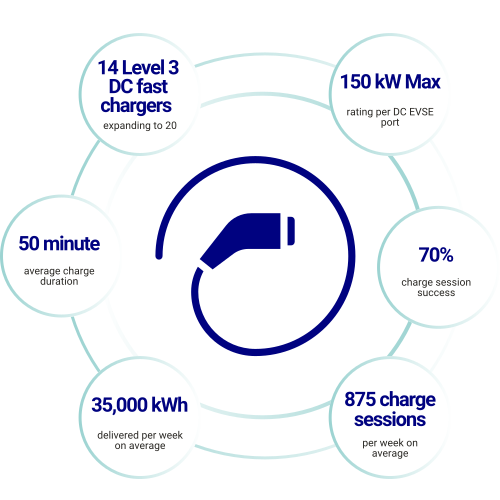
Tower Mobility operates highly utilized EV chargers that recharge fleet electric vehicles. They were looking for a Charging Station Management System (CSMS) to help them better understand how their Los Angeles EV charging operation, consisting of fourteen DC EVSE ports each rated up to 150kW, was performing from the electric utility interconnection to the charging plugs.
For this application vehicle throughput was high and vehicle dwell times were unpredictable, so Tower Mobility wanted to ensure the CSMS did not throttle power or prohibit charge attempts.
This case study highlights the solution selected by Tower Mobility which utilized SkySpark implemented by kW Engineering, an engineering consulting firm and system integrator.
The Solution: kW Engineering + SkySpark = Data-Driven EVSE Management
Tower Mobility partnered with kW Engineering, a trusted energy systems integrator, to implement a customized Charging Station Management System (CSMS) powered by SkyFoundry’s SkySpark.Using kW Link, kW’s proprietary platform built on SkySpark—the system integrated directly with Tower’s EV chargers via the OCPP 1.6J protocol, the industry standard for charger communication. The kW team tailored dashboards, KPIs, and real-time alerts to match Tower’s operational needs, ensuring full visibility without disrupting ongoing charge sessions.
SkySpark, deployed globally across over 20,000 facilities and nearly two billion square feet, provided a robust foundation for energy management, asset tracking, and fault detection, making it an ideal fit for high-demand EV charging environments like Tower Mobility’s.
System Integration Expertise
kW Engineering’s expertise as a systems integrator was instrumental in deploying an analytics-driven EV charging station management system (CSMS) for Tower Mobility. By leveraging their deep knowledge of energy management and system integration, kW seamlessly connected Tower Mobility’s 14 DC EVSE ports each rated up to 150kW, to SkyFoundry’s SkySpark platform, delivering a tailored solution that optimized charging operations while ensuring scalability for future expansion to 20 ports.
The project began with a site visit by kW Engineering to Tower Mobility’s Los Angeles charging station. This hands-on assessment allowed the team to evaluate the physical layout, including the EV chargers’ configuration and their integration with the electrical grid. Observing live charging sessions provided key insights into operational challenges, such as high vehicle throughput and unpredictable dwell times. kW was also able to verify the charger configuration settings were configured properly to remote communication in a secure manner. This direct engagement ensured the solution met Tower Mobility’s specific needs.
Post-site visit, kW Engineering shifted to remote integration, configuring SkySpark to communicate with the EV chargers via its OCPP 1.6J connector. They collaborated with the EVSE manufacturer to align firmware updates and configuration settings, ensuring compatibility and optimal performance. This partnership was vital for a smooth commissioning process.
Monitoring Key Performance Indicators
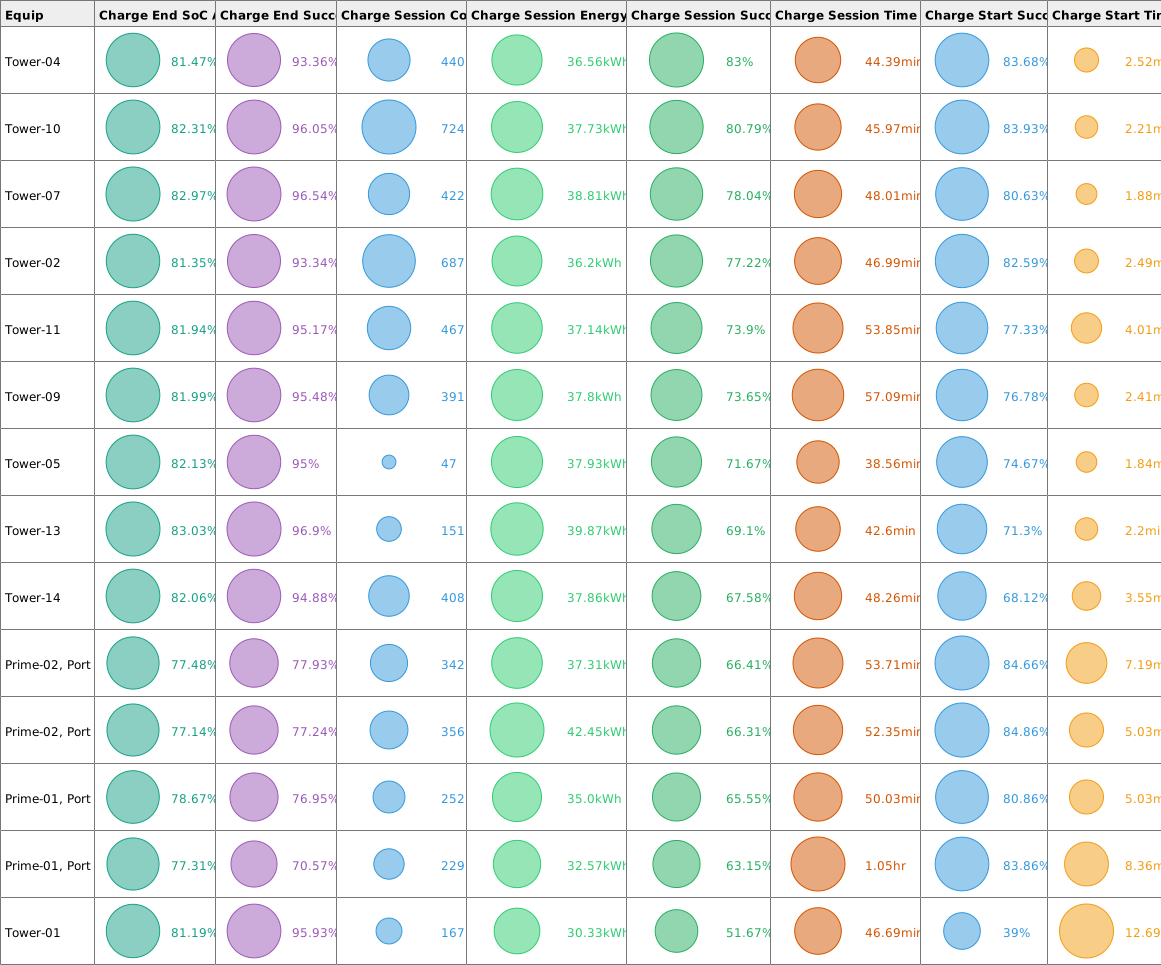
SkySpark’s built-in rule engine and KPI rules for EVSE were used to calculate historical and real-time KPIs for each EVSE port and across all EVSE ports at the site. Some of these KPI rules were inspired by work conducted by the ChargeX Consortium.
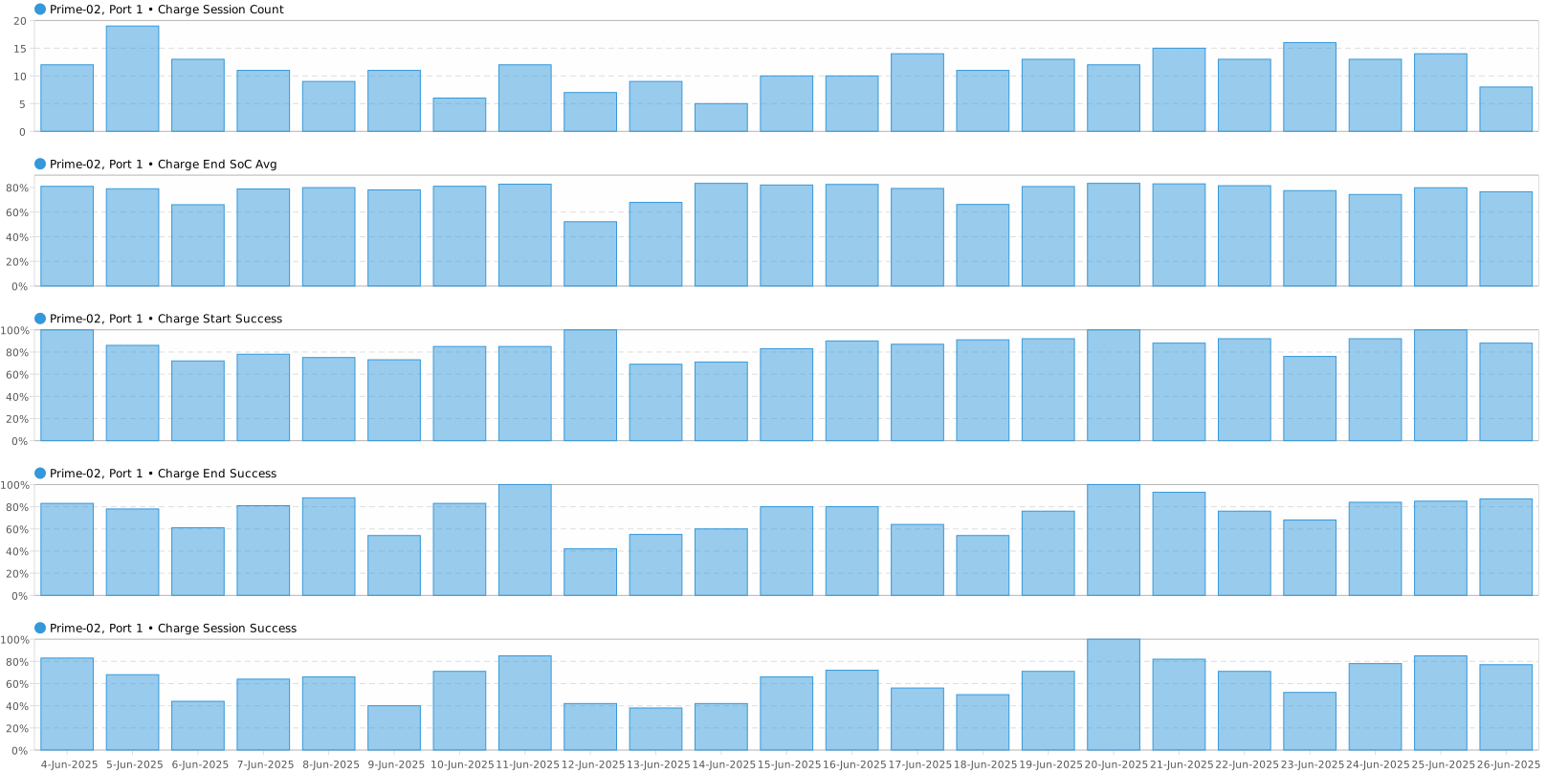
SkySpark’s out-of-the-box KPI app visualizes the KPIs. This app allows the user to benchmark EVSE ports at the site to one another (Figure 1), analyze EVSE port trends (Figure 2), and benchmark site performance with just a few clicks.
Detecting Equipment Faults
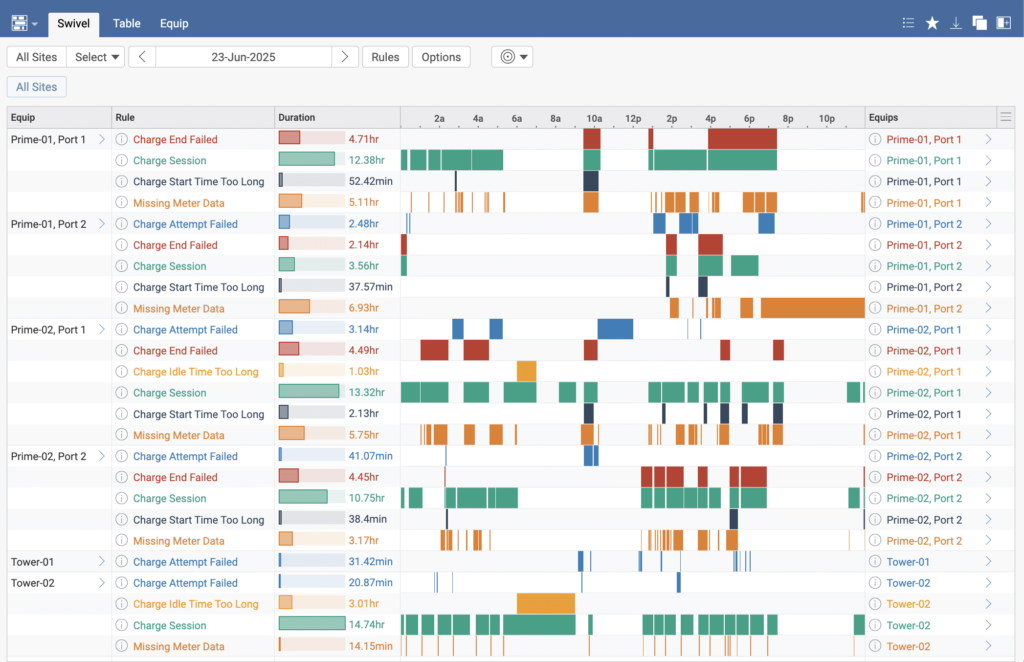
SkySpark’s built-in rule engine and Spark rules for EVSE were used by Tower Mobility to detect equipment faults, patterns, or deviations from expected performance.
For example, the Spark rule “Charge End Failed” detects charge sessions that do not end with either of the following successful criteria:
- Vehicle state of charge (SoC) greater than a user defined threshold (e.g., 78%)
- An “EVDisconnected”, “Local”, “Remote”, or “UnlockCommand” OCPP 1.6J stop reason reported within 2 minutes of the EVSE port’s status transition from occupied to available
The events detected by the Spark rule “Charge End Failed” are used to compute the “Charge End Success” and “Charge Session Success” KPIs. Other KPIs similarly use Spark rules for their computation.
Interactive visualizations within SkySpark’s Spark app help operators better understand their KPIs, equipment and detected faults by displaying raw data reported by the EVSE. The Show Me view shows the specific data points associated with the detected spark to avoid overwhelming the user. Controls within the Spark app allow users to see how many faults occurred and how long faults occurred within any defined time (e.g., last week).
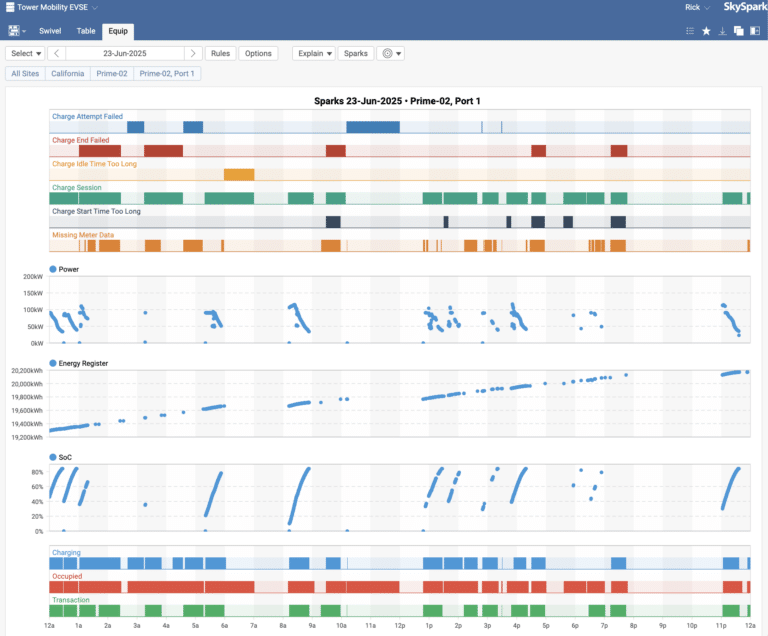
Detecting Equipment Faults
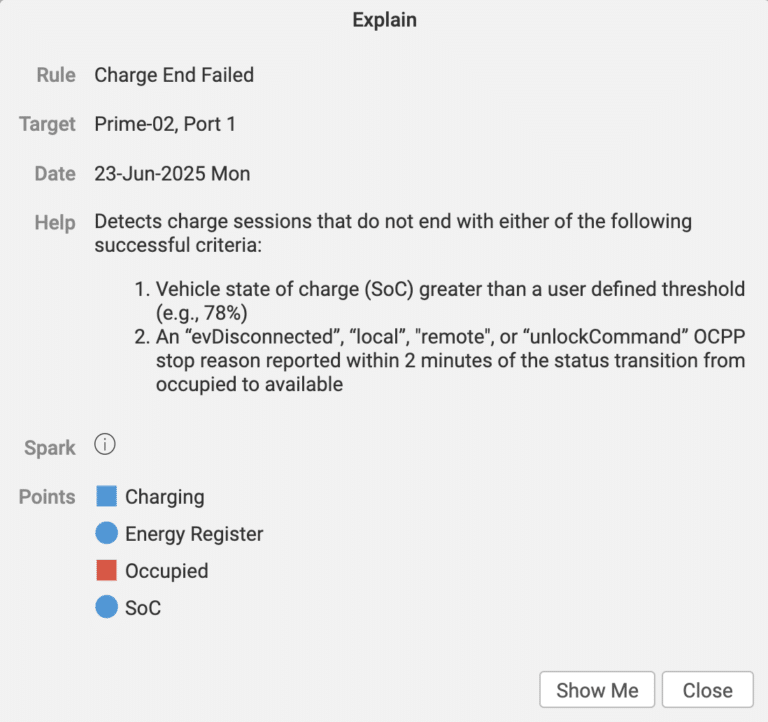
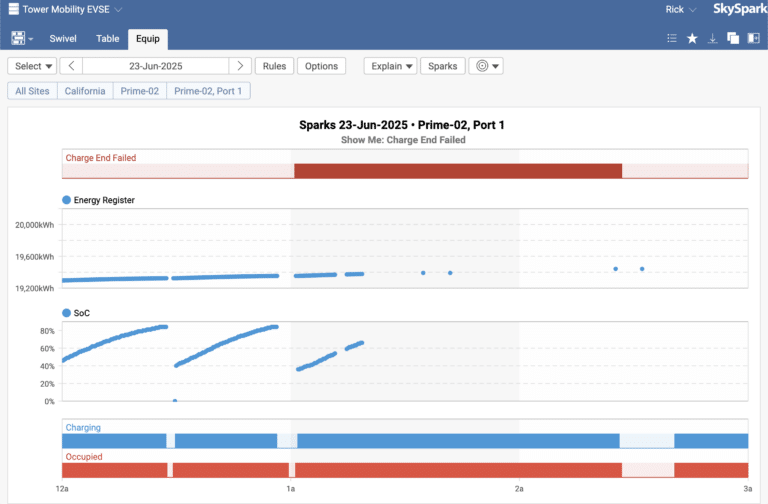
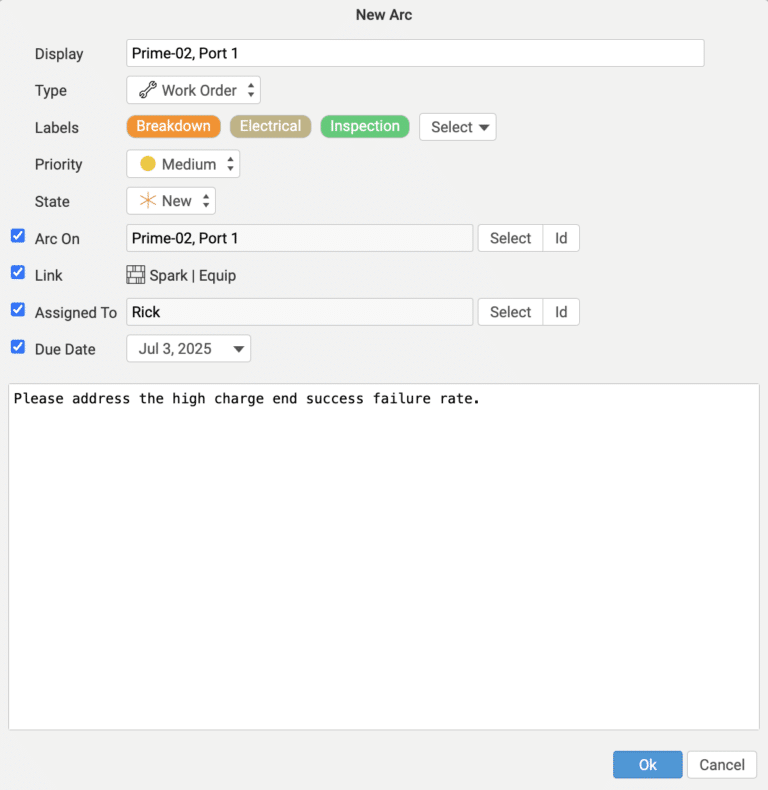
Work orders, which include a link to the Spark | Equip view, can be generated directly within SkySpark or SkySpark can integrate with third party Computerized Maintenance Management System (CMMS) to enable the service team to take improvement actions.
Fulfilling Project Specific Requirements
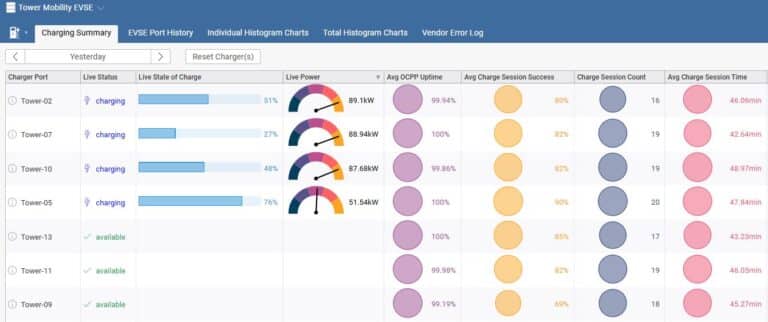
SkySpark can be extended when needed by SkyFoundry community partners. kW leveraged SkySpark’s customizability to tailor build a series of dashboards that met the exact requirements outlined by Tower Mobility. A monitoring dashboard was developed that showed real-time details of every charger port. This allows Tower Mobility staff to ensure all the chargers are being utilized efficiently and notified when charge sessions are complete or if a charger needs attention due to a fault.
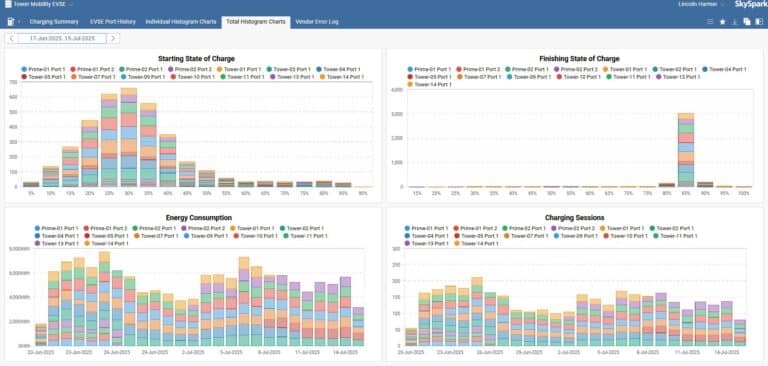
Additionally, a dashboard showing the average vehicle starting state of charge, average vehicle finishing state of charge, average charger energy usage, and total charge session count over a selectable date range to determine that the chargers and vehicles are being properly utilized over time.
Conclusion
Operating a successful EV charging business requires more than just hardware—it demands a robust software platform for system integration, KPI tracking, performance benchmarking, fault detection, work order management, and load control. These capabilities are essential to stay competitive in a rapidly evolving market
SkySpark is a comprehensive data platform with out-of-the-box EV charging features that can be used to address these requirements for fleet and other EV charging applications. SkySpark gives kW Engineering and Tower Mobility an advantage when control is required by already including battle-tested KPI tracking and fault detection features that are becoming expected in the EV charging industry.
In summary, kW Engineering’s role as a systems integrator bridged technical and operational gaps, delivering a CSMS that enhanced visibility, efficiency, and collaboration for Tower Mobility’s EV charging operations.
Share the Impact with your Team
Download the full PDF case study for easy saving and sharing with your team.